Who Usually Pays — The Landlord Or The Tenant?
More often the landlord — but it genuinely varies. Most places expect the property owner to keep a rental habitable and free of pests, so treatment of the home usually lands on them. Tenants can end up paying where a lease clause, a local rule or the facts of how the bugs arrived point the other way.
There is no single national answer, and anyone who gives you one without asking where you live is guessing. Responsibility is decided by a mix of your state and city rules, your lease wording, the type of property — a single rented house is handled differently from a flat in a large building — and sometimes how the infestation is judged to have started.
In multi-unit buildings the owner's involvement is hard to avoid either way: bed bugs move between adjoining homes through wall voids and shared corridors, so effective treatment has to be coordinated across units. A tenant treating one flat alone, on their own bill, rarely finishes the job.
What Actually Decides Who Pays?
Four things decide most cases: your local law, your lease, the building type, and the timeline. Written notice and photographs are what turn those from opinions into a record — which is why the first steps below matter as much as the rule itself.
Start with the lease, because in several states it carries real weight: find the pest control clause and see who is named. Then the property: a landlord who rents a whole house may point at the lease, while the owner of an apartment block usually cannot separate one unit's bugs from the building's problem. Then the facts — a problem reported the week you moved in reads differently from one reported a year into a tenancy after a trip abroad, though 'who brought them in' is almost never provable and good landlords know it.
Whatever the outcome, both sides keep duties: the paying side arranges a proper treatment with follow-up visits, and the tenant side does the preparation, grants access and reports new signs fast. Most failed rental treatments fail on cooperation, not on money.
How Does It Usually Work In Florida?
Florida has no bed-bug-specific rental statute. The general landlord duty to maintain the premises under Florida's landlord-tenant law is the framework most disputes use, and extermination responsibilities can shift with the type of property and the lease wording. In practice, Florida landlords commonly arrange and pay for treating their rentals.
Because the lease matters more in Florida, read yours before the argument starts, and put your report in writing with dates and photos. If you and your landlord read the duty differently, your city or county code enforcement office can say what applies at your address.
The company doing the work is a separate, clearer question: pest control businesses in Florida are regulated by the Florida Department of Agriculture and Consumer Services (FDACS), whose Pest Control Licensing and Certification office can confirm any firm you are quoted by — worth doing whoever is paying.
Need Bed Bug Treatment Help Near You?
One free call connects you with a local pro who can arrive in 30–60 minutes.
Call (800) 555-0100Free Call · Answered 24/7 · Local Pros Near You
How Does It Usually Work In New York?
New York puts the clearest duties on owners. In New York City, owners are responsible for keeping homes bed-bug-free and for eradicating infestations, tenants must be given a property's bed bug history on a disclosure form, and buildings file an annual bedbug report with the city's Department of Housing Preservation and Development (HPD). Tenants elsewhere in the state are covered by the warranty of habitability.
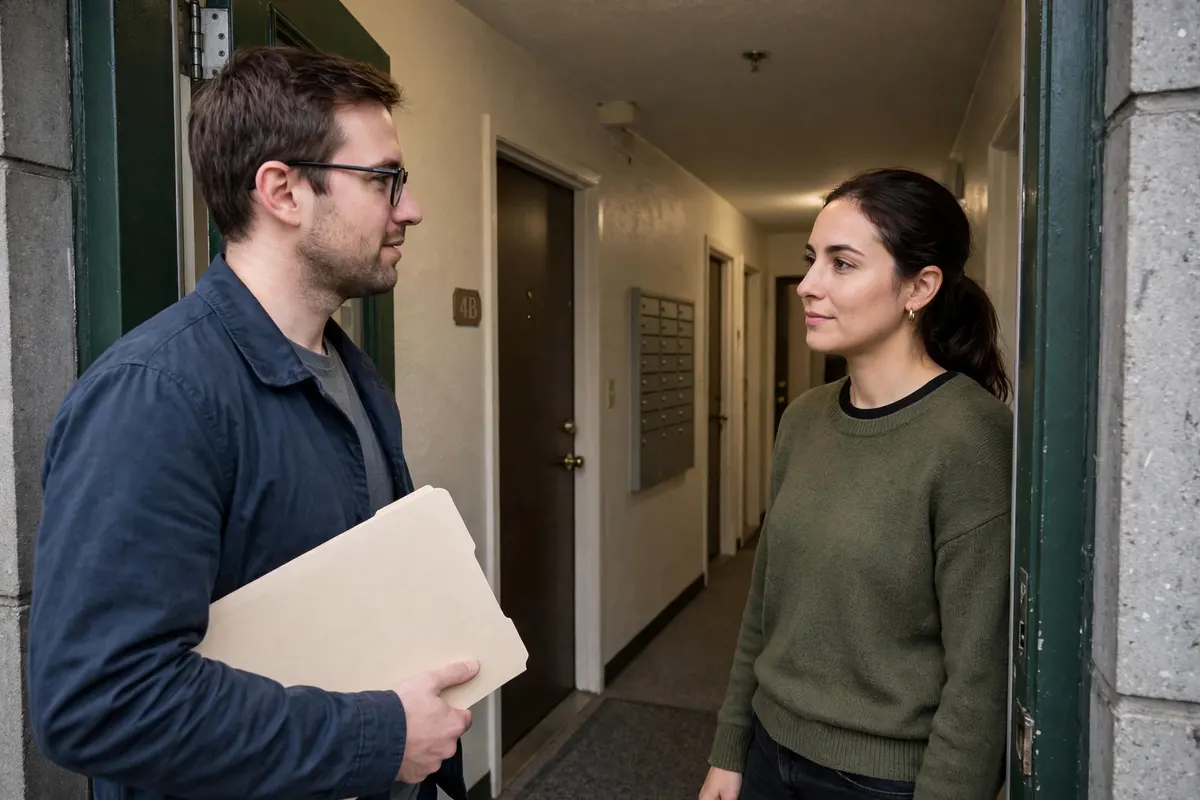
For NYC renters the route is well worn: notify the owner or manager in writing, keep photos and dates, allow access for inspection and treatment — and if nothing is arranged, HPD's bedbugs page is the official starting point for complaints. Refused access is the most common reason treatments stall, and it weakens a tenant's position, so cooperate visibly and keep records of it.
The treatment companies themselves are regulated separately, by the New York State Department of Environmental Conservation (NYSDEC) pesticides program — that is who verifies a company's registration, whichever side chose them.
How Does It Usually Work In Texas?
Texas has no bed-bug-specific rental statute either. The Texas Property Code gives tenants a process for getting health-and-safety conditions addressed after proper written notice, and pest responsibilities are often shaped by the lease. Many Texas leases assign routine pest control to tenants, but a whole-home bed bug infestation is a different scale from routine spraying, and it is usually treated as a property condition.
The notice is the Texas tenant's strongest tool: report in writing, keep proof it was sent, and re-report if signs continue. If a dispute stalls, your city's code compliance office is the local route, and legal aid organisations advise tenants on the repair process free of charge.
Pest firms working in Texas are regulated by the Texas Department of Agriculture's Structural Pest Control Service — verify any company there before money changes hands. And photograph your lease's pest clause now; if it clearly assigns pest costs to you, budget for a conversation about scope rather than a refusal to treat, because an untreated infestation only gets more expensive.
Should Treatment Start Before The Argument Is Settled?
Yes, and it should not wait for the money argument to finish. Bed bugs multiply on their own schedule — eggs hatch in about a week to ten days — and a two-week dispute can double the job. Get the inspection done, agree in writing who is provisionally paying, and argue about the invoice with the treatment already running.
Tenants: do not book your own budget treatment in secret and present the bill afterwards; reimbursement for self-arranged work is one of the hardest costs to recover, and a one-off spray can scatter the bugs and complicate the real program. Landlords: a fast, proper treatment with follow-ups is almost always cheaper than the vacancy, re-letting and adjoining-unit costs of a problem left to grow.
If neither side will move, your housing or code office complaint creates the paper trail that usually unlocks it. Meanwhile, follow the first-night rules — stay in the bed, move nothing room to room, no foggers — so the problem the invoice covers stays the size it is today.
Whichever side of the lease you are on, the inspection that starts the paper trail is one free call — Bed Bug Treatment Albany, NY, Bed Bug Treatment Austin, TX or Bed Bug Treatment Alachua, FL.
A Short Field Glossary
A few terms run through every inspection report and treatment plan. The species behind nearly every case is Cimex lectularius, the common bed bug. A bed bug egg is a millimetre long, pearly white, and glued into a seam or crack where sprays rarely reach. A bed bug nymph moults five times before it can breed, and it needs a blood meal at every stage. Pros call the colony's daytime hiding place a harborage — a seam, crack or void within reach of the bed. Fecal spots, tiny black dots of digested blood, gather on the seams and frame where the colony rests. Shed skins (exuviae) are the papery shells left behind at each moult, and they collect beside the seams where the colony rests. Rusty stains on bedding come from crushed, blood-fed bugs rolled on in the night.
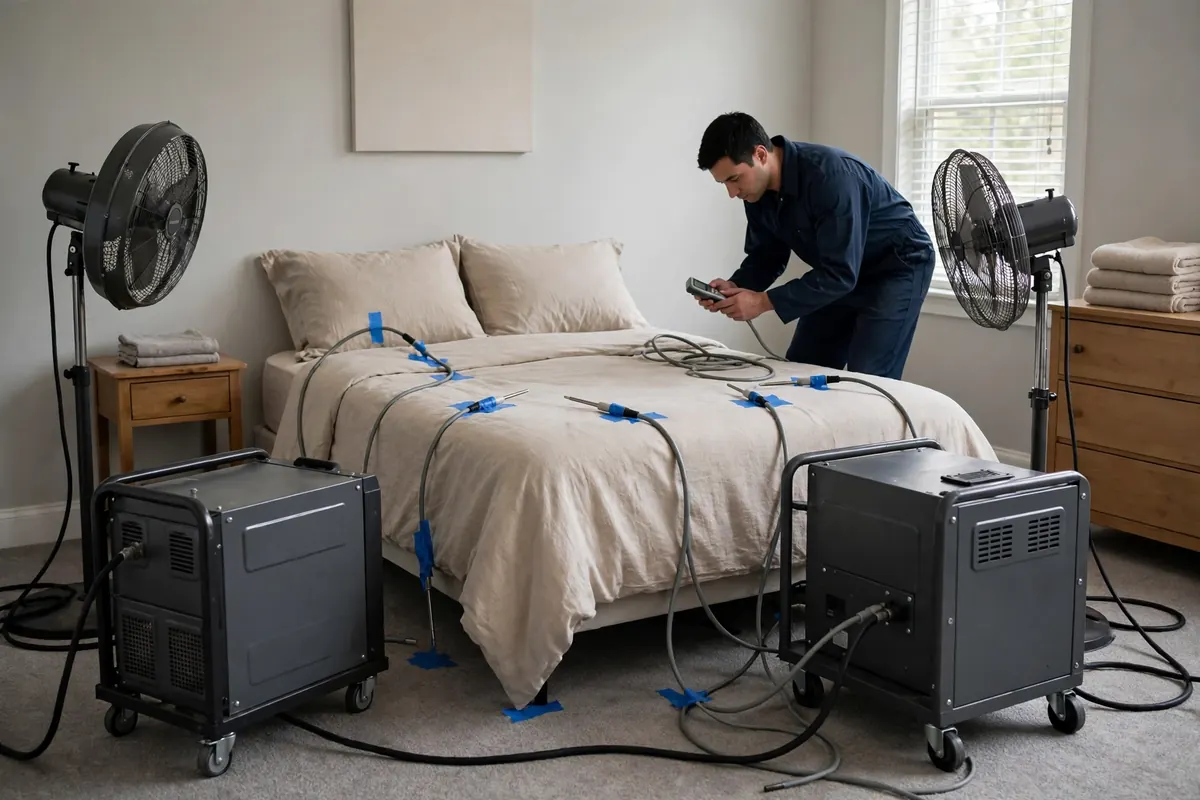
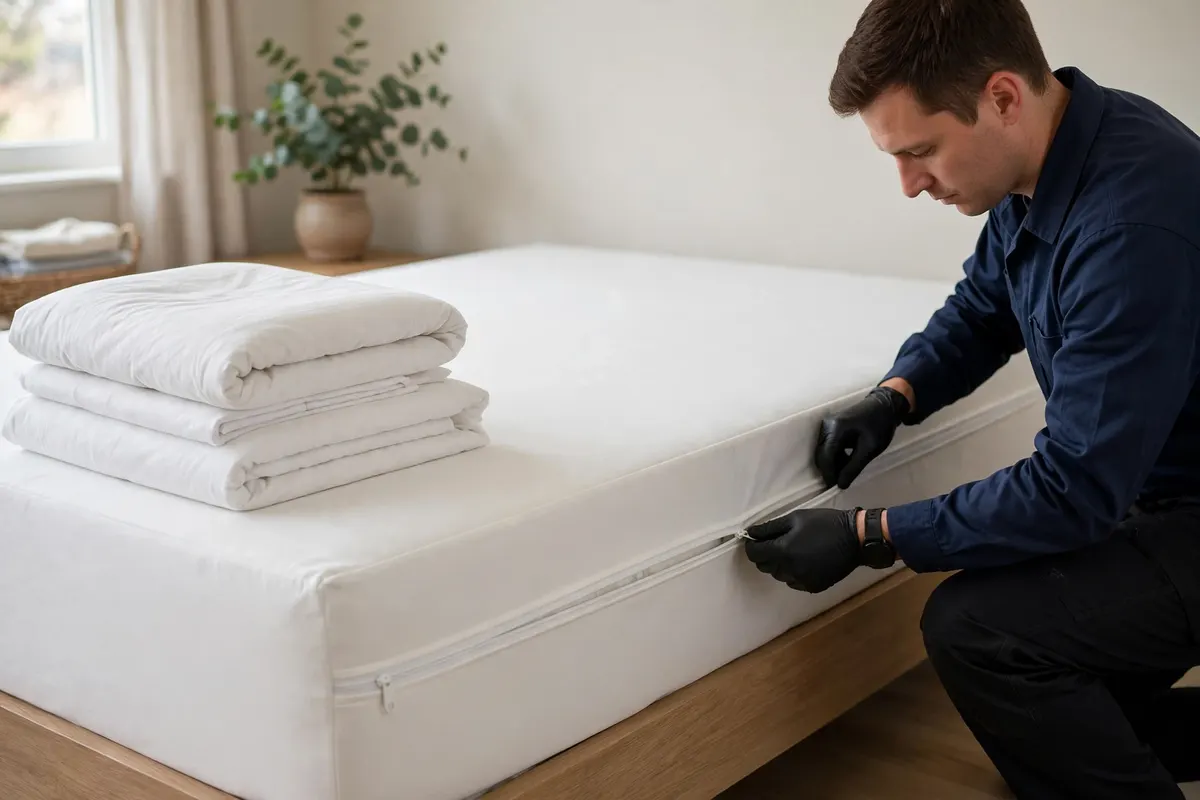
The tools behind the terms are just as plain: Interceptor traps under the bed legs catch climbers in both directions and show whether any remain. A passive monitor tucked at the head of the bed gives wandering bugs a harbourage that can be checked in seconds. A mattress encasement seals the bed itself, so nothing can hide in its seams or tufts. A box-spring encasement does the same for the base, whose torn fabric and staples hide colonies well. K9 scent detection can sweep a room in minutes, the dog's nose finding what eyes miss in clutter. Everything starts with a visual inspection — seams, screw holes, headboard backs and the joints of the frame. Thermal heat remediation raises the whole room to a lethal temperature and holds it there until every stage is dead.
The bill argument feels urgent, but the bugs are on a faster clock. Inspect first, agree who pays in writing, and let treatment start while the paperwork catches up.