How Long Should The Encasement Stay On?
At least a year is the standard professional advice — because an encasement works partly as a starvation trap, and a trapped bed bug can survive many months without a meal.
Work backwards from the bug. Bed bugs are built for famine: in cool, undisturbed conditions, a bed bug sealed away from any host can survive for many months — commonly quoted survival without feeding runs toward a year. An encasement fitted over an infested or treated mattress seals any survivors inside, where they cannot reach you, cannot feed, and therefore cannot breed. The cover only finishes that job once every trapped bug is dead, and the calendar for that is set by the longest-lived bug inside, not by your patience.
That is why pros give the same answer in Bed Bug Treatment Bartow, FL as everywhere: fit it, zip it, and leave it — a full year at minimum, and many households simply keep encasements on permanently, because the protection and the easy inspections continue long after the starvation job is done. Taking the cover off at three months 'to check' restarts the risk at exactly the moment the survivors are hungriest.
How Does An Encasement Actually Work?
It seals the mattress inside a bite-proof, escape-proof barrier — bugs already inside cannot get out to feed, and bugs outside lose the seams they live in.
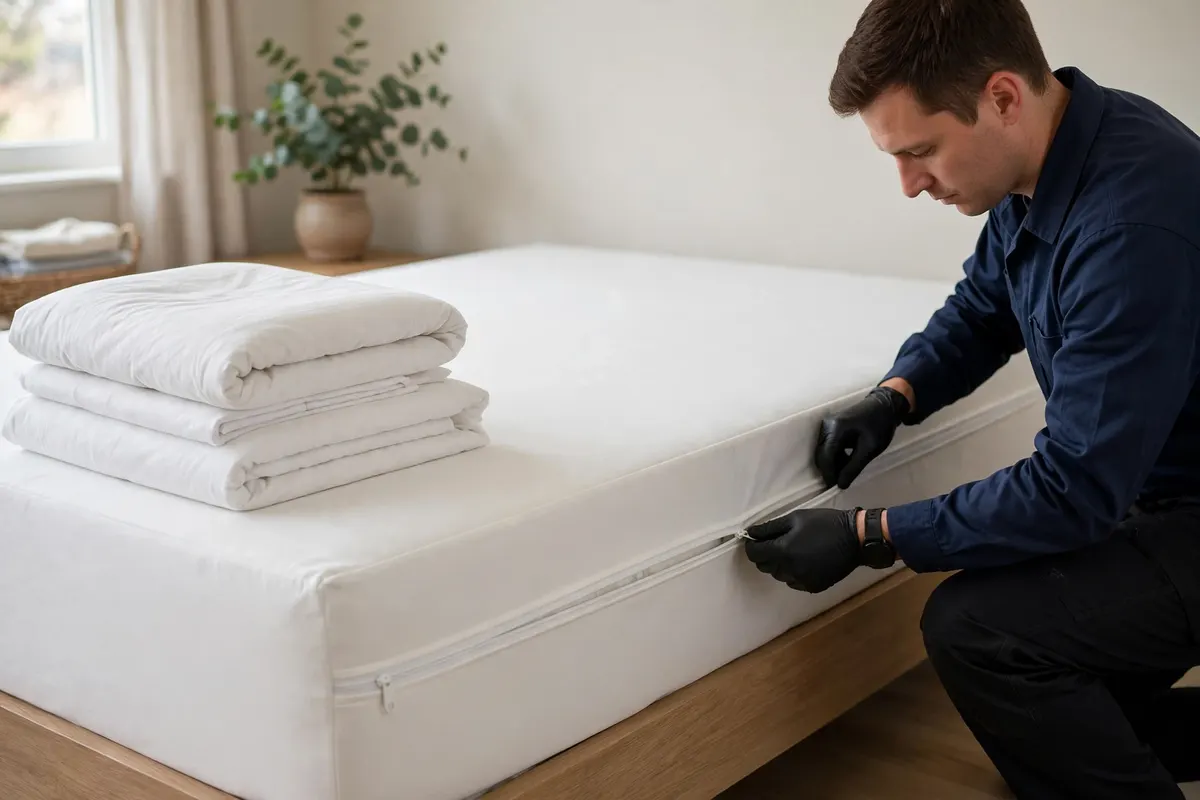
Two jobs in one zip. First, containment: the encasement's fabric and zip are fine enough that no life stage — not an adult, not a first-stage nymph fresh from an egg — can pass through, and the material cannot be bitten through. Anything sealed inside is cut off from its food supply permanently. Second, harbourage removal: a mattress's seams and piping are the bed bug's favourite address, and a smooth encasement buries them under a featureless surface. Bugs forced to shelter on the outside of the cover have nowhere good to hide, and you can spot a single fecal dot on it in seconds.
That second job is why encasements stay useful after an infestation is over. The bed becomes the easiest item in the room to inspect, monitors and interceptors around it work better, and any new hitchhiker arriving in luggage or furniture finds the safest hiding place in the room already closed.
An encasement also changes how follow-up works. During an active program, the pro is no longer digging through mattress seams at every visit — the population inside is already written off — so inspection time goes to the frame, the room and the monitors, which is where surviving bugs actually are. And because the cover is pale and smooth, your own weekly check takes seconds: a torch along the surface while you change the sheets, looking for a single new dot.
What Makes An Encasement Bed-Bug-Proof Rather Than Just A Cover?
Fit and the zip: a tested encasement is checked so no life stage escapes, has a zip that seals fully with a covered end-stop, and fabric that cannot be bitten through.
Ordinary mattress protectors fail all three tests: their zips have gaps at the end-stop big enough for a nymph, their fabric can be bitten through or is only waterproof rather than bug-proof, and they often cover five sides, leaving the base open. Look for encasements sold specifically as bed bug proof — laboratory-tested escape and bite resistance is the claim that matters — with a locking or fully sealing zip, an end-stop that is covered so the zip's final millimetre is not an open door, and a fit sized to your mattress depth so the cover is smooth, not baggy.
Baggy matters. Excess fabric folds into new creases — new harbourages on the outside of the very cover meant to remove them. Measure the mattress depth before ordering, fit it snugly, and fit the box spring too: leaving the box spring bare while encasing the mattress protects the wrong half of the bed, because the box spring's hollow frame and dust cover are prime harbourage in homes like those covered by Bed Bug Treatment Albertson, NY.
An encasement does not kill the infestation — it locks the mattress out of it, and lets time and starvation do the rest.
Need Bed Bug Treatment Help Near You?
One free call connects you with a local pro who can arrive in 30–60 minutes.
Call (800) 555-0100Free Call · Answered 24/7 · Local Pros Near You
Does An Encasement Treat The Infestation By Itself?
Yes — it is a control tool, not a standalone treatment. What it does, it does completely; everything outside the cover still needs the rest of the plan.
When In The Treatment Should Encasements Go On?
During treatment, not after it: the pro inspects and treats the mattress and box spring first, then the encasements go on as the sealing step of the same job.
The order matters. Fitting an encasement over an uninspected mattress and calling it done is the classic mistake — you have sealed in an unknown population with no treatment at all, and while starvation will eventually handle it, 'eventually' is doing heavy lifting while the rest of the room goes untreated. The proper sequence on a treatment visit is: inspect the mattress and box spring seam by seam, treat what is found, vacuum and steam as the plan requires, then fit both encasements and zip them closed.
From that moment the covers are part of the evidence system. At follow-up visits the pro reads the smooth surfaces like a dashboard: a new fecal spot on the encasement means something is still active outside it, in the frame or the room, and the search redirects there. Households in Bed Bug Treatment Arlington, TX hear the same instruction at this point: the encasement is fitted — now nobody opens it.
What Can Go Wrong With An Encasement?
Almost never tear it, never unzip it to check, and replace it if it rips — that handful of rules is the whole maintenance burden for the year it must stay on.
Tears are the main enemy: a cover dragged across a sharp bed-frame corner or snagged by a staple can rip, and a rip is a door. Check the bed frame for sharp edges and protruding staples before fitting, pad any you find, and lift — never drag — the encased mattress when the bed is moved. Small tears discovered later can be sealed with strong tape as a stopgap, but a badly torn cover should be replaced, carefully, ideally while a pro is treating anyway. The zip is the second weak point: it must sit fully closed, end-stop covered, every time you change the bedding over it.
Sheets and ordinary bedding go over the encasement as normal, and the encasement itself does not need washing during its sealed year — washing it means unzipping it, which is the one thing you must not do. If the year passes and you choose to keep it on (most people do), inspections stay easy forever. Readers planning the wider treatment can see how encasements fit into state-level programs at Bed Bug Help In Texas. One free call connects you with a local pro who can arrive in 30–60 minutes and fit encasements as part of a proper treatment, not as a substitute for one.
A Short Field Glossary
A few terms run through every inspection report and treatment plan. The species behind nearly every case is Cimex lectularius, the common bed bug. A bed bug egg is a millimetre long, pearly white, and glued into a seam or crack where sprays rarely reach. A bed bug nymph moults five times before it can breed, and it needs a blood meal at every stage. Pros call the colony's daytime hiding place a harborage — a seam, crack or void within reach of the bed. Fecal spots, tiny black dots of digested blood, gather on the seams and frame where the colony rests. Shed skins (exuviae) are the papery shells left behind at each moult, and they collect beside the seams where the colony rests. Rusty stains on bedding come from crushed, blood-fed bugs rolled on in the night.
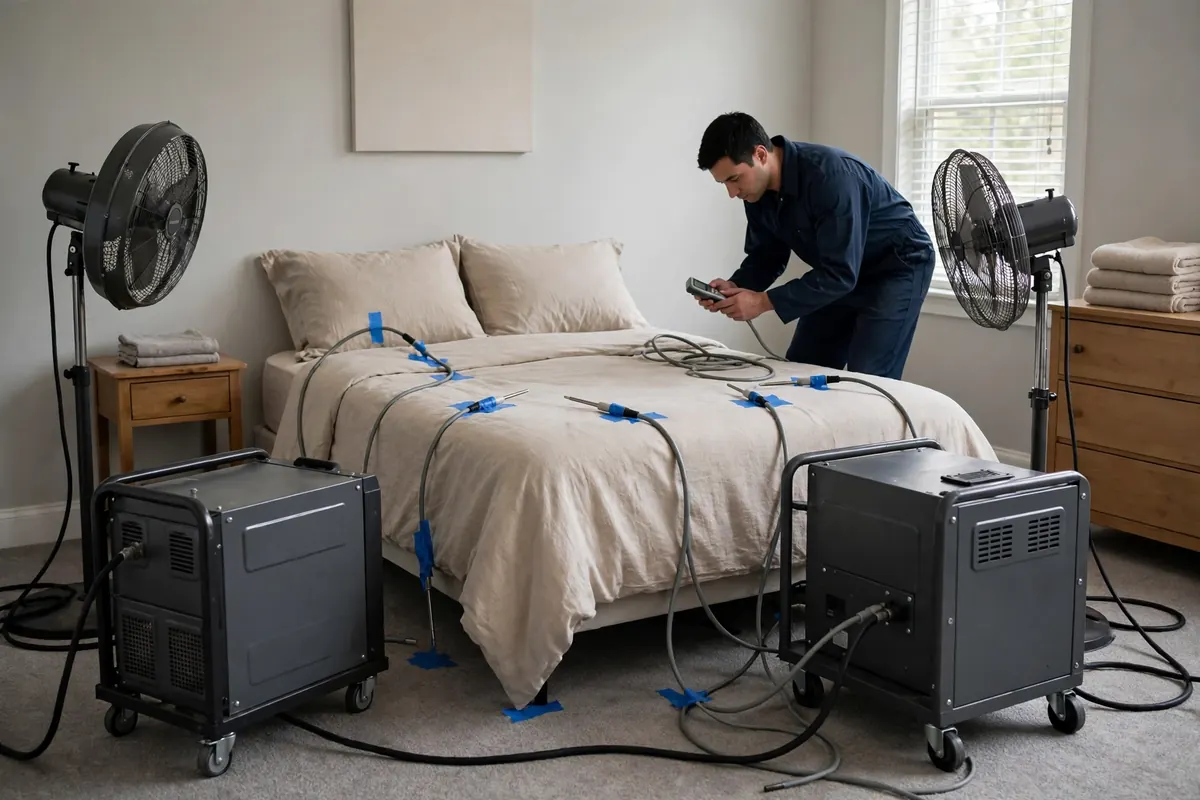
The tools behind the terms are just as plain: A passive monitor tucked at the head of the bed gives wandering bugs a harbourage that can be checked in seconds. A encasement seals the bed itself, so nothing can hide in its seams or tufts. A box-spring encasement does the same for the base, whose torn fabric and staples hide colonies well. K9 scent detection can sweep a room in minutes, the dog's nose finding what eyes miss in clutter. Everything starts with a visual inspection — seams, screw holes, headboard backs and the joints of the frame. Thermal heat remediation raises the whole room to a lethal temperature and holds it there until every stage is dead.