Why Does Luggage Matter So Much?
Because bed bugs are hitchhikers, not invaders. They do not come through walls or up from drains — they ride home in seams, zips and pockets, then walk from the suitcase to the nearest bed.
A bed bug's whole travel strategy is hiding. In a hotel room it shelters near the bed — headboard, mattress seams, nightstand joints — and a suitcase left on the bed, the luggage rack beside it or the floor nearby is simply another dark, undisturbed harborage within crawling range. One pregnant female in a zip pocket is enough to start a home infestation, and because some people do not react to bites, weeks can pass before anyone knows she arrived.
That is why returning travellers using Bed Bug Treatment Austin, TX hear the same advice as travellers anywhere: the suitcase is treated as suspect until it has been checked and cleared. Not with panic — with a routine.
Where Should You Unpack?
Somewhere that is not the bedroom: a garage, a utility room, or the classic inspector's choice — inside a white bathtub, where anything that crawls out is easy to see and cannot easily escape.
The single worst place to open a suitcase is on the bed; the second worst is the bedroom floor. Both put any hitchhiker within a short walk of its new home. Unpack somewhere hard-surfaced and away from sleeping areas, keep the case itself off upholstered furniture, and do not carry armfuls of trip clothing straight onto the bed 'to sort later'. Sorting happens at the inspection point, and washable clothes go from there directly into a bag for the laundry, not into the bedroom laundry basket.
If you travelled from a room where you actually saw signs — fecal spots on the mattress, shed skins, a live bug — say so to yourself plainly and upgrade the routine: the case stays outside the living space entirely until everything in it has been heat-treated, a standard that applies in Bed Bug Treatment Arlington, TX just as anywhere else.
How Do You Inspect The Case Itself?
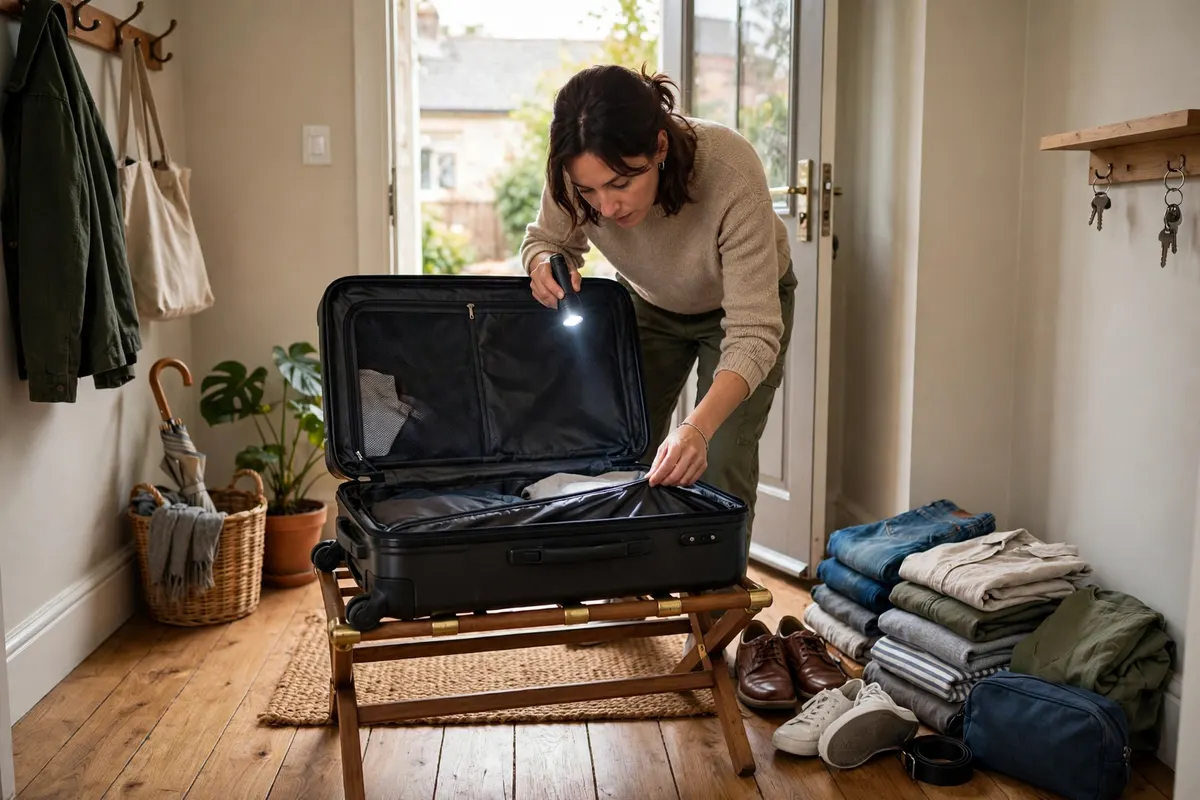
Slowly, with a bright torch, along every seam, zip track, corner and pocket — the same places an inspector checks on a mattress. You are looking for live bugs, fecal dots, rusty stains and pale shed skins.
Work the case like a pro works a bed. Empty it fully, then run the torch along the piping and seams, inside and out; open every pocket and invert the lining where it will come; pay attention to zip ends, handle housings, wheel wells and the corners where fabric meets frame — tight, dark, undisturbed junctions are the harbourages. Hard-shell cases have fewer hiding places but are not exempt: bugs shelter in the zip track and the telescopic handle housing.
Use the signs, not bites, as your evidence — the EPA's guidance is that bites are a poor indicator of an infestation. A live, apple-seed-sized reddish-brown insect is a confirmation. Tiny dark spots that look like marker dots, rusty smears, and translucent shed skins are the supporting cast. If you find a suspect, photograph it before you disturb it: a clear photo is exactly what a pro needs to confirm the identification.
What About The Clothes Inside?
Clothing is lower risk than the case, but it rides in the same bag. Anything washable goes straight to the machine — and it is the dryer, more than the wash, that does the killing: a full cycle on high heat reaches temperatures bed bugs and their eggs cannot survive. Items that cannot be washed can often simply be tumble-dried on high heat for a full cycle if the fabric tolerates it. Delicates that tolerate neither should be bagged and sealed while you ask a pro — do not just hang them back in the wardrobe and hope.
Need Bed Bug Treatment Help Near You?
One free call connects you with a local pro who can arrive in 30–60 minutes.
Call (800) 555-0100Free Call · Answered 24/7 · Local Pros Near You
What Should You Do With Everything After Inspection?
By item type. Heat handles most of it; the honest answer for a few delicate things is bagging and professional advice rather than a home remedy.
The suitcase is the border crossing of every infestation. Inspect it like one.
Where Should The Suitcase Live Afterwards?
In a garage, a shed, or sealed in a large bag — anywhere that is not beside, under or on the bed it travelled to reach.
Under-bed storage is the one place a checked-but-not-cleared case should never go: if a single bug survived inspection, under the bed is the shortest possible commute to its first meal. Store travel gear away from sleeping areas, and if you travel often, keep the routine identical every trip — consistency is what makes it work, the same habit travellers returning to Bed Bug Treatment Altamonte Springs, FL are coached into. A case used weekly by a frequent traveller deserves a standing inspection habit, not a one-off effort after a scare.
A simple luggage cover or a large sealed storage bag adds a second layer between trips: anything that did survive inside the case stays inside the bag, and the bag itself becomes part of the inspection — checked at the same time, in the same place, before the case is opened. It takes a minute. Storage discipline is the unglamorous half of travel prevention, and it is the half that decides whether one missed bug becomes a breeding population or a dead end.
What If You Actually Find A Bug?
Do not panic, and do not spray the case. Photograph it, isolate the suitcase somewhere away from beds, heat-treat the contents, and call for an inspection of the bedroom before anything spreads.
One bug found and dealt with at the suitcase stage is a story with a happy ending; the failures happen when people find one, squash it, and assume it was alone. A female may already have laid eggs in the case — eggs hatch in about six to ten days at room temperature — so the bedroom deserves a professional check of the mattress seams, frame and headboard, and interceptor traps under the bed legs will catch any nymph that emerges. Tell the pro it is a travel introduction: it changes where they look first.
And skip the fogger. Foggers do not kill bed bugs in hiding places and can scatter them deeper into the home — the one move that reliably turns a suitcase problem into a whole-house problem. Readers under Bed Bug Help In New York hear the same sequence: isolate, heat what can be heated, inspect, and let evidence — not anxiety — decide the next step.
The Words Pros Use For All Of This
Guides like this one translate as they go, but on a call you will hear the trade's own terms. The species behind nearly every case is Cimex lectularius, the common bed bug. A bed bug egg is a millimetre long, pearly white, and glued into a seam or crack where sprays rarely reach. A bed bug nymph moults five times before it can breed, and it needs a blood meal at every stage. Rusty stains on bedding come from crushed, blood-fed bugs rolled on in the night.
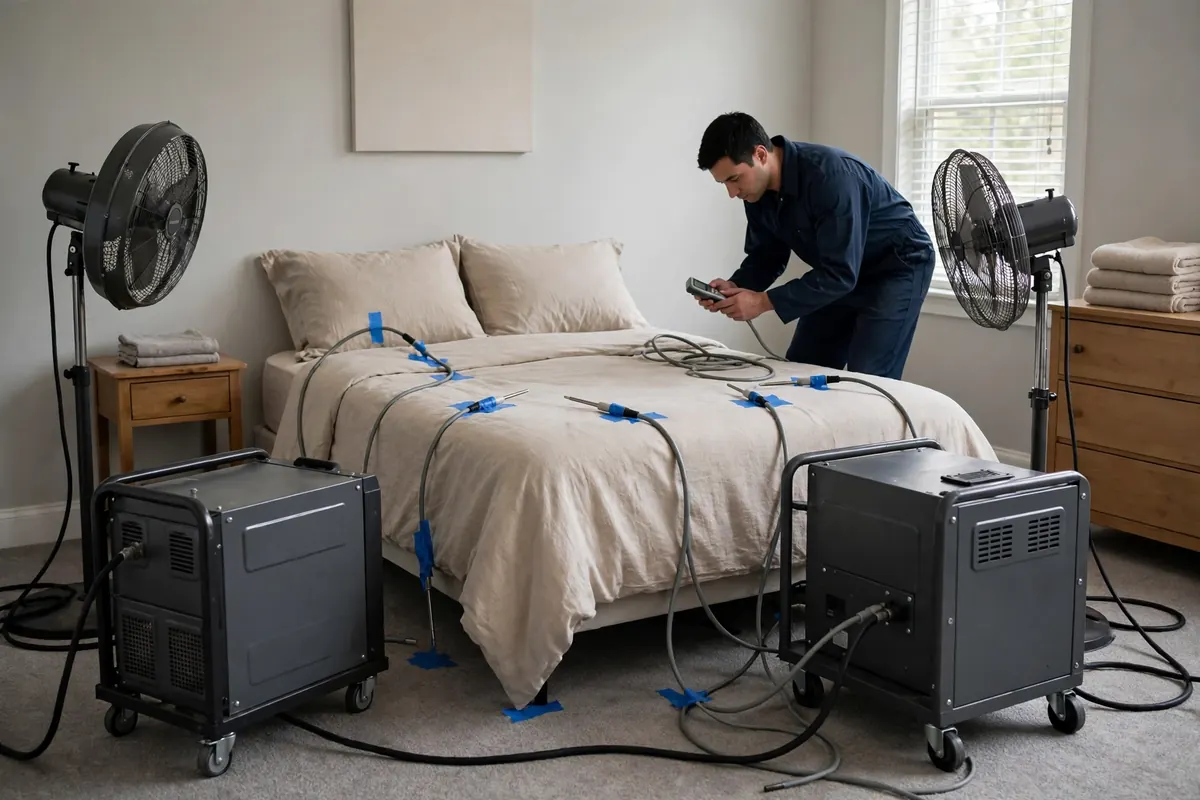
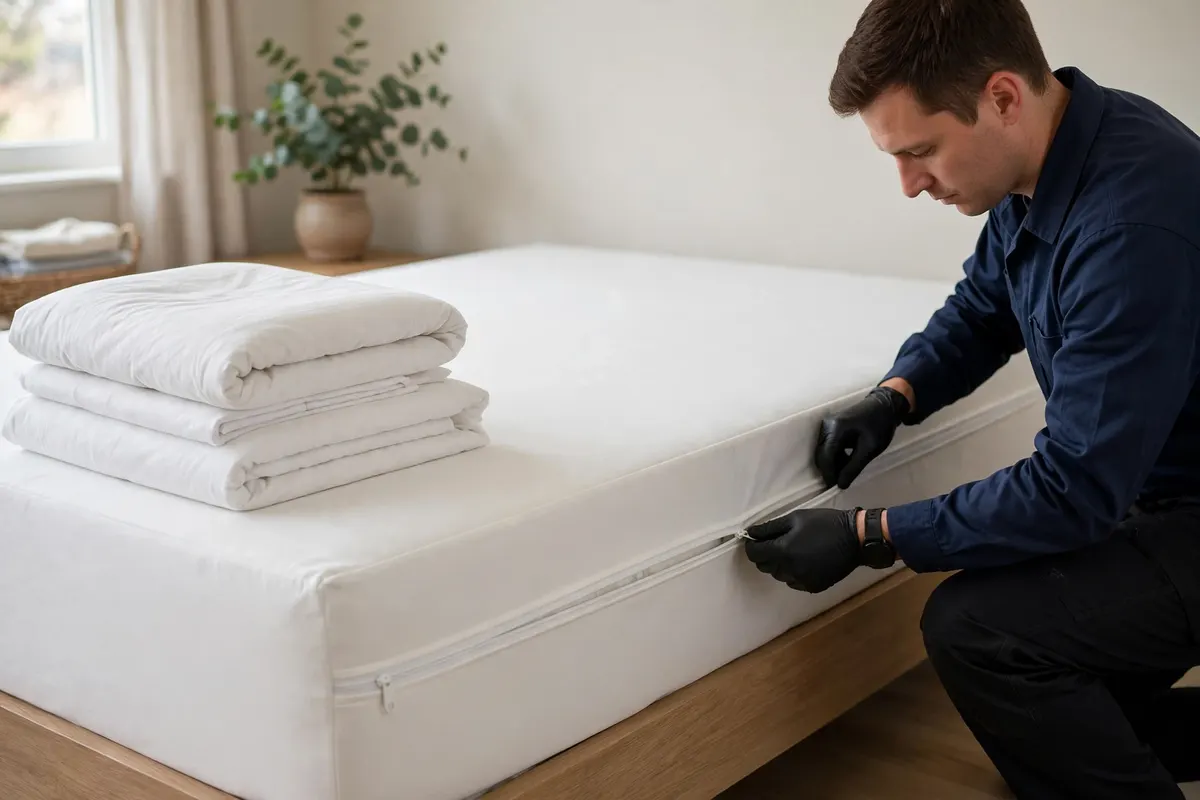
The kit those terms describe is simple: A passive monitor tucked at the head of the bed gives wandering bugs a harbourage that can be checked in seconds. A mattress encasement seals the bed itself, so nothing can hide in its seams or tufts. A box-spring encasement does the same for the base, whose torn fabric and staples hide colonies well. K9 scent detection can sweep a room in minutes, the dog's nose finding what eyes miss in clutter. Everything starts with a visual inspection — seams, screw holes, headboard backs and the joints of the frame. Thermal heat remediation raises the whole room to a lethal temperature and holds it there until every stage is dead.